


Somewhere in the stack of paperwork you sign before a move, there’s a line about coverage. When you get your quote, your mover asks you whether you’d like full value or released value coverage. Often, people just go with the cheaper option. But it’s important to understand what your level of coverage means, and what it would do if a box came off the truck damaged.
A great mover handles your belongings with care. But when the unexpected happens, your chosen level of coverage makes a difference. This post is meant to give you the information you need to understand your moving coverage.

What’s the difference between released value and full value protection?
To start, many people are surprised to learn that coverage isn’t the same as insurance. In the moving industry it’s called valuation, and it’s the mover’s limit of liability for your belongings. Valuation is set by law and by the level you pick. Real insurance is a separate product you can buy on top of your valuation, usually through a third-party insurer. Ask your Move Consultant and they can lay out your options.
On a long-distance move that crosses state lines, federal rules require your mover to offer two coverage levels, and you choose one.
Released value is the basic option, and it’s usually included at no extra charge. If something is damaged in transit, released value coverage pays based on the weight of the item, not what it’s worth. The federal figure works out to about sixty cents per pound, per item. A heavy, inexpensive item is often covered close to its value. A light, valuable one is only covered at a fraction of its market value or replacement rate.
Full value protection costs more, and it’s built around replacement instead of weight. If something is lost or damaged under full value coverage, the mover is required by law to either repair it, replace it with a comparable item, or settle for its current replacement value. It’s the level most people picture when they assume their things are “covered.”

How does released value coverage work?
Picture a small collectible that weighs almost nothing but is worth thousands of dollars (like a piece of jewelry or art). Under released value, its payout is figured by the pound. That would mean that a featherweight item can settle for a few dollars no matter what it’s worth. This level of coverage is right for some moves. However, it’s important to understand what weight-based coverage means.
In contrast, full value protection exists to cover items that are both light and valuable: art, electronics, jewelry, collectibles. Under full value coverage, damages are reimbursed based on what it costs to replace them, not weight. If you have high value items (generally one hundred dollars per pound or more), they have to be listed on the paperwork ahead of time so the mover knows they’re in the shipment. If these items aren’t declared, the mover can limit what full value pays on these items.

 For moves within Texas, do the same federal rules apply?
A move that stays within Texas follows Texas rules, and Texas doesn’t set a minimum level of coverage. When a move crosses state lines, movers must offer full value protection, with released value as the 60-cent-per-pound fallback. On a Texas intrastate move, the coverage is whatever your contract spells out. It could match the federal figure, it could be different. Texas law even allows it to be as low as zero if the contract says so plainly. It’s very important to understand the coverage level listed on your paperwork before you sign.
What if the movers damage my house instead of my things?
A good crew protects your walls and floors as carefully as the boxes. But sometimes a wall still gets bumped or a floor scratched. When this kind of damage occurs, there’s a separate system of reimbursement. Coverage levels like released value and full value apply to your belongings, the things being carried. They don’t apply to your actual home.
If a crew puts a hole in a wall or scratches a floor, that’s damage to real property. There’s no per-pound limit on it, and movers must repair the damage. The claim is filed directly with the company that caused the damage.

What about an international move?
Coverage also works differently for international moves. Belongings are covered by federal released value or full value coverage during the US leg of travel. Once your belongings leave the country, the rules of the ocean or the air take over. A shipment traveling by sea falls under a federal law that caps liability at five hundred dollars per package unless you declare a higher value. A shipment going by air runs under a treaty limit of roughly thirty-five dollars per kilogram. For the overseas leg, the real protection is usually separate marine cargo insurance, which is genuine insurance rather than valuation. If your move is headed abroad, ask which leg any coverage figure describes before you rely on it. Your Move Consultant can point you to the right coverage for each leg of an overseas move.
How a claim settles, and why you should ask
How a specific claim pays out depends on several things at once: which coverage level you chose (released or full value), whether the move was inside Texas or across state lines, the weight and value of the item, and the details of what happened. That’s case by case, so the honest answer to “what would I get” is a conversation you have with your mover before you book.
As you consider a potential mover, it’s important to find out:
- Ask which coverage levels they offer
- Ask them to walk through what released value would pay on your two or three most valuable items, and whether full value is worth it for your shipment.
- Ask for the coverage terms in writing, so the answer isn’t a memory of a phone call.
- Ask whether they own their vehicles and employ their own crew. We’ve talked before about why it’s important to be cautious of moving brokers. When damage occurs on a brokered move, it can be difficult to resolve with various people pointing fingers at each other.
A mover who can answer these questions plainly is showing you how they’ll handle the claim if you ever need to file one.
Coverage is one piece of a full service move
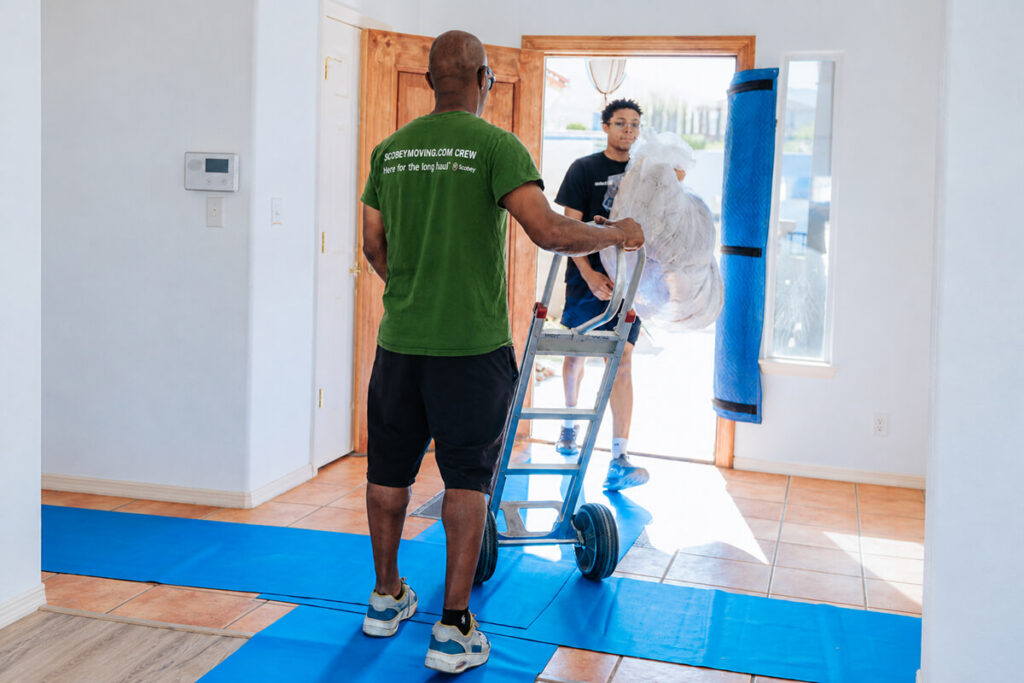
Deciding on coverage is one of the hundreds of decisions that come along with a move. Some decisions (like the level of coverage you need) only you can make. But many of the others? A full service mover (also called turnkey, end-to-end, or white glove moving) takes the rest of these off your plate. The same team handles the packing, the padding, the loading, coordination of details, and the delivery. Fewer hand-offs mean fewer chances for a dresser to pick up a scratch in the first place.
White glove moving also means one person stays with you the whole way. Your Move Consultant walks you through the process, from your first quote to the last box unpacked. Coverage is one of the choices they help you sort out before moving day.
Scobey Moving and Storage has been moving Texans since 1913. We’ve helped thousands of customers understand what their coverage protects. You’re already deciding on dates, addresses, and a hundred details. You shouldn’t have to also decode a coverage line on your own.
If you’ve got questions about which coverage level fits your move, we’d be glad to walk you through the options. Whatever your move needs, we’ve got you covered.
Contact Scobey Moving and Storage today to learn how to have a move that’s covered from end to end.
Frequently Asked Questions
Full value protection is the higher of the two coverage levels a mover offers. Despite being commonly called insurance, valuation is a different process governed by different policy terms, and on an interstate move it means Scobey Moving and Storage can repair a damaged item, replace it, or settle it at its current replacement value instead of paying by weight.
The two types are released value and full value protection. Released value is the basic, no-cost level that pays by an item’s weight, about sixty cents per pound per item on an interstate move, while full value protection costs more and covers repair or replacement at current value.
Full value protection is usually worth it when your shipment includes anything light but valuable, since released value pays only by weight, about sixty cents per pound per item on an interstate move. For a load of sturdy, lower-value goods, released value can be enough, so ask your Scobey Move Consultant to weigh the cost against what you’re moving.
A mover’s responsibility for a damaged item is capped by the coverage level you picked, released value or full value protection, and some causes can be excluded. What you collect depends on that level, so it can range from a few dollars by weight to full replacement value. Damage to your home, like a dented wall or a marked floor, is handled separately and repaired in full, with no per-pound limit.
Valuation coverage is a mover’s limit of liability for your belongings rather than an insurance policy, and Texas requires the moving contract to state that difference in writing. It covers loss or damage to the goods being moved up to the level you select, and you can buy separate insurance on top of it.
Full value protection still has limits: items worth more than a set amount per pound (generally one hundred dollars a pound or more), only carry that full value if you list them on the paperwork before the move. And because full value protection is valuation and not insurance, it only covers loss or damage the mover is responsible for. Something the mover couldn’t control, like a fire or a storm, isn’t covered by valuation, so for that you’d need separate moving insurance.

Eric Barker is the Vice President of Commercial Services at Central Transportation Systems and a recognized voice in the moving and relocation industry. With over a decade of experience in military household goods logistics, operations, and commercial moving services, Eric has played an active role in shaping conversations around the future of PCS (Permanent Change of Station) moves and military relocation policy. He currently serves on the board of the Southwest Movers Association and the IAM DAB DMV (International Association of Movers, Distinguished Agents Board, DMV chapter), reflecting his ongoing commitment to industry leadership and standards. He recently joined industry leaders at the 50th Annual Dispatchers Convention to discuss the major structural changes affecting military moving in 2026. Through his leadership and operational expertise, Eric helps ensure military families receive reliable, efficient, and professionally coordinated moving services during periods of significant industry transition.