


Think about the items in your home. The jeans in an outdated style that have been in the back of your closet for years. The kitchen gadget that seemed essential and got used maybe twice. The furniture that settled into a corner at the last place and never really worked there either.
Every home has a list like this. And when a move is on the horizon, you finally have to decide what to do with those items. You’ve probably heard that process called decluttering, and chances are good the thought of it makes you feel (at least a little) overwhelmed.
But there’s another way to think about it: curating.
A museum curator doesn’t empty the galleries. They decide what earns a spot on the wall, what belongs in storage, and what gets retired entirely. There’s intention behind every piece.
When you curate your belongings, you’re making decisions about what belongs in your life right now, and what you want to bring with you into your new home.
Here’s how to declutter your home room by room with a curator’s eye.
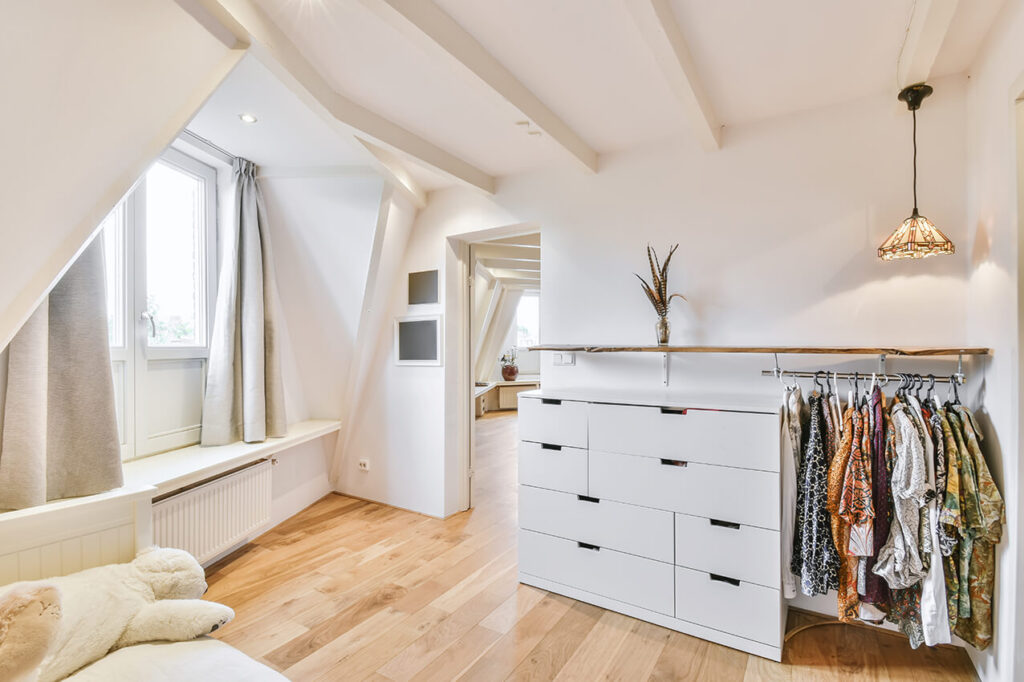
Where Should You Start When You Declutter Your Home Room by Room?
Start with the room that bothers you most. Most people have one room that’s the reason they keep putting this off, and the temptation is to begin somewhere easier first. If you’ve been dreading going through the garage, start in the garage. If it’s the bedroom closet, go there first. The room carrying the most mental weight gives you the most momentum once it’s done.
Before you pull anything off shelves, do a quick first pass and remove only what’s obviously out: trash, broken items, things that belong in another room. Don’t make keep-or-donate decisions yet. Just clear the noise so you can see what you’re working with.
Then ask the curator’s question about everything that’s left: does this belong here?
To help you begin building your move, we’ve created this free, downloadable PDF moving checklist.

How Do You Declutter a Living Room Without Losing What Makes It Yours?
The living room is an area where a lot of people get stuck. It’s the room families spend the most time in, and it holds the things that feel most personal: art you’ve collected over the years, photos from family trips, furniture that started in another house and followed you here.
The goal is to be intentional about what you put on display, rather than stripping the room down to a minimalist showcase.
Start with surfaces. Shelves, mantels, and side tables collect things by default. Pull everything off and put back only what you’d choose to put there today. Plenty of it will have a story attached, and that’s exactly why the curator’s version of the question is narrower: would I choose this for this room if I were starting over?
A few questions worth asking as you go:
- Does this piece of furniture make the room work, or does it just take up space?
- Are these decorative items ones you still love, or ones you’ve stopped seeing?
- Is there anything in this room that belongs somewhere else in the house?
Once the extras are gone, the things you kept become visible again. A shelf with four things on it reads as a display. A shelf with twenty is more likely to read as a catch-all.

What’s the Best Way to Declutter a Bedroom?
The bedroom is a tough room to curate because it’s also the most private. Closets with clothes you haven’t worn in three years. Books you’re going to read… someday.
When you’re decluttering a bedroom, the closet is a great place to start. The common rule is that if you haven’t worn something in over a year, there’s a good chance you won’t in the future. But the more useful question is this: if you were packing for a move right now, would this item earn its place on the truck?
That question cuts through a lot of sentimental hesitation. Deciding whether something has value in the abstract is nearly impossible, because almost everything has value to someone. Curating asks something narrower: does it have value to YOU, in this season of your life?
Work through the rest of the room the same way: nightstands, under the bed, the top of the dresser. Every surface and every drawer gets an honest look. What would you choose to bring into a brand-new space? That’s what stays.
You don’t have to handle any part of your move alone. White glove moving (also called turnkey, end-to-end, or full service moving) can include the decluttering itself, so you make the keep-or-donate calls and someone else handles the sorting, the hauling, and the donation runs.

How Do You Declutter a Kitchen (Without Getting Rid of Things You Actually Use)?
The kitchen feels high-stakes because everything in it is a potential tool… which makes it hard to let go of anything. But most kitchens hold duplicates, gadgets bought for a single recipe, and items taking up a whole drawer while contributing nothing.
Start with the cabinets. Pull everything out and group by category: baking, cooking, prep, storage. You’ll see immediately what you have two or three of, and what you haven’t touched in longer than you can remember.
A few questions that help:
- Do I cook with this, or did I buy it for a meal I made once?
- Do I have two of these because I need two, or because I never made a decision about the extra?
- Would I buy this again if I were stocking a brand-new kitchen?
The pantry and the countertops follow the same logic. Counter space is premium real estate, so reserve it for what you reach for every day.

What About Overlooked, “Catch-All” Spaces?
Bathrooms, home offices, and garages tend to collect the things that never had anywhere else to go. They’re the default landing zone for whatever you weren’t sure about but kept anyway.
Bathrooms fill up fast with expired products, travel-size toiletries from three years ago, and duplicates you forgot you bought. Pull everything out, check dates, and put back only what’s in regular use.
Home offices collect paper the way kitchens collect gadgets. Expect outdated tech, user manuals, and boxes from your Ring camera and smart home equipment. Go through every drawer and surface and sort into three piles: keep, scan, recycle.
The garage gets its own category. It’s usually the space that causes the most stress, because it takes the longest and holds the biggest items. Start by grouping everything: tools, sports equipment, holiday decorations, boxes you’ve never opened. Anything still sealed since the last move is a strong candidate for the donation pile.
The garage might be the room you start with, if it’s the one that’s been bothering you. But if it isn’t, saving the catch-all spaces for last means you’ve already built the habit everywhere else in the house. By the time you get there, the curator’s question comes without much effort.

How Does Full-Service Moving Fit Into a Curated Home?
Curation changes what moving day looks like on the logistics side too.
When a full-service moving team (sometimes called white glove movers) arrives at a home that’s been curated, every item going on the truck has already earned its place. The move coordinator plans the sequence clearly: which rooms get packed first, how the truck is loaded, what needs special handling.
That clarity shows up in the estimate and on the calendar. Your mover can quote more accurately when the scope is defined. Packing moves faster when nobody is standing in a hallway waiting on a decision. And unpacking is a different experience when every box was filled on purpose.
How much of this you hand off is your call. Some people curate every room themselves and hand over a finished house. Others want help from the first closet through the last box unpacked in the new kitchen. A full-service move can cover the whole arc: decluttering, packing, loading, transport, unpacking, and setting up the new home so it’s ready to live in on day one.
The heirlooms, the furniture worth keeping, the pieces you want in this next chapter: those get the care they deserve. White glove moving exists for exactly that, getting the things that matter to you into the new house in the same condition they left the old one.

A Curated Home Is a Lighter Move
When you’ve decluttered your home room by room, the hardest decisions are already behind you. What’s left is the work, and that’s the part we’d love to take off your hands. Whether that means packing an already-curated house or helping you sort the garage before a single box gets taped.
Ready to start? Contact Scobey Moving and Storage today. We’d love to help you plan a move that’s streamlined from start to finish.
Frequently Asked Questions
Start with the room that’s been bothering you the longest. Do a first pass to clear obvious trash and misplaced items, then work through what’s left with one question: does this belong here? Finishing one room builds the momentum that carries you into the next.
The difference is the standard you judge by: decluttering asks what you can get rid of, while curating asks what you would choose again if you were starting fresh. The end result can look similar, but curating gives you something concrete to measure against, and it tends to leave you with fewer regrets after you unpack.
Decluttering before a move is almost always the better choice. Curating first means you’re not paying to transport things you’ll donate a week after you unpack. You also arrive with a clear sense of what belongs in each room, which makes unpacking faster and less overwhelming.
Ask whether you’d load the item onto a moving truck, rather than whether you’ve worn it in the past year. The moving-truck version is more concrete and easier to answer. For anything you’re unsure about, start a maybe pile and revisit it at the end, once you can see the full picture.
Full-service moving (also called white glove moving) at Scobey Moving and Storage covers packing, loading, transport, and unpacking at the new home, and it can start earlier with decluttering support. A move coordinator plans the sequence: which rooms get packed first, how the truck is loaded, and what needs special handling. You decide how much of it to hand off.

Eric Barker is the Vice President of Commercial Services at Central Transportation Systems and a recognized voice in the moving and relocation industry. With over a decade of experience in military household goods logistics, operations, and commercial moving services, Eric has played an active role in shaping conversations around the future of PCS (Permanent Change of Station) moves and military relocation policy. He currently serves on the board of the Southwest Movers Association and the IAM DAB DMV (International Association of Movers, Distinguished Agents Board, DMV chapter), reflecting his ongoing commitment to industry leadership and standards. He recently joined industry leaders at the 50th Annual Dispatchers Convention to discuss the major structural changes affecting military moving in 2026. Through his leadership and operational expertise, Eric helps ensure military families receive reliable, efficient, and professionally coordinated moving services during periods of significant industry transition.