


You closed on the old house on a Friday. The closing on the new house isn’t until the end of the month. For a few weeks in between, everything you own has to be somewhere that isn’t either of those addresses. What do you do with your packed household between your move out and move in dates?
Sometimes a gap like this is expected, but most of the time it’s not. You plan for the sale and you plan for the new house, then a closing date moves. Having a gap between homes can be one of the more stressful parts of a move. But it happens more often than you might think, because real estate deals don’t always line up exactly.
Storage in transit moving is the service built for exactly these situations. When your mover offers storage in transit, your belongings get loaded onto the truck once, stay in the mover’s warehouse for as long as the gap lasts, and are delivered to the new house when you’re ready. That way, you’re not renting a unit and moving your own things twice. The same company that packs the house holds it and brings your belongings to your new home.

What Is Storage in Transit During a Move?
Storage in transit, sometimes shortened to SIT, is temporary warehouse storage of a shipment that’s already under your mover’s care. After the moving truck leaves your old home, your belongings come off the truck into the warehouse, are stored during the gap, and are loaded back on the truck for final delivery. One load out of the old house, one delivery into the new one, and the warehouse in the middle.
The term itself comes from long-distance and interstate moving, where a shipment often needs to wait before the last leg. On a move that stays inside Texas, the same arrangement is usually called short-term warehouse storage, and it works the same way for you: your household stays with the company that moved it. What changes is which rules apply to the storage, which matters most if the gap runs long, and we’ll get to that below.
A benefit of storage in transit over a self-storage unit is avoiding the double handling. When you rent a unit yourself, your furniture gets loaded off the truck, carried into the unit, then loaded again onto whatever brings it to the new house. Having to move in and out of a self-storage unit doubles up the manual labor, and increases chances of damage to your belongings. Storage in transit keeps your belongings on the mover’s inventory the whole time.

When Do You Need Storage Between Homes?
Any time your move-out date and your move-in date don’t overlap, there’s a storage gap. It usually happens for ordinary reasons, and sometimes can’t be avoided:
- The buyer of your old home needs a firm possession date that lands before your new closing.
- The sellers of your new home need extra days to move out or finish a repair.
- A loan or an inspection pushes one side of the deal by a week.
- A new build isn’t finished on the date the calendar promised.
A gap can be as short as one night or stretch into several weeks, and you might not know how long it will be until you’re close to the date. Because it can vary, planning for storage in transit can be a great solution. That way, whether the gap is four days or a month, you’re covered and don’t have to worry about logistics.
How Does Storage in Transit Moving Work, Step by Step?
The sequence is built to keep your things on one inventory from start to finish.
- The crew packs and loads the house, and everything is inventoried as it goes on the truck.
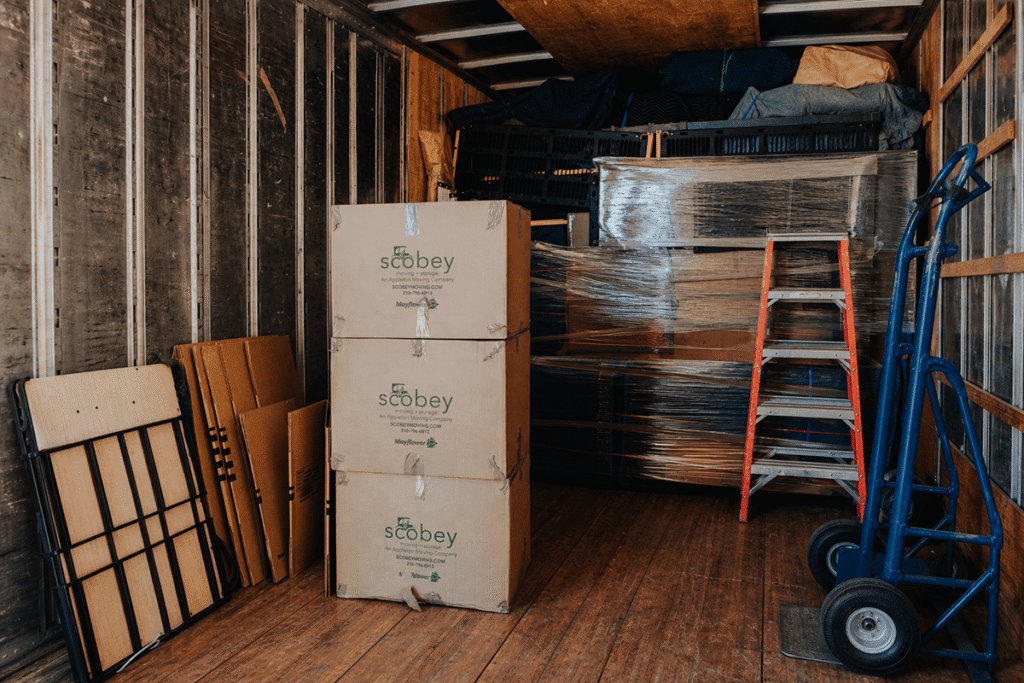
- Instead of driving to a new address, the shipment goes to the mover’s warehouse and is placed into storage, often in wooden vaults that keep each household separated and stacked off the floor.
- Your belongings wait there through the gap, tracked on the same inventory the crew built on loading day.
- When your new home is ready, the shipment is loaded back out and delivered, and you check it in against that same inventory.
Because it’s one company and one inventory, you have a point of contact for the whole process rather than a moving company on one end and a storage operator on the other.

What Does Storage in Transit Cost?
Storage in transit is usually billed in three separate parts, and knowing the shape of the bill matters more than any single number:
- A handling fee to move your belongings into the warehouse and, later, back out.
- A monthly storage charge for the time they’re held.
- A redelivery fee to bring the shipment from the warehouse to your new home.
Storage is billed by the month, so a gap of four days and a gap of twenty days can fall inside the same billing period. That’s worth knowing, because it means a short slip in your closing might not change the bill at all, while a longer one can tip you into a second month. The exact handling, monthly, and redelivery figures vary by mover and by the size of your shipment, so the number to ask for is all three in writing, not a single monthly rate quoted over the phone. A full service mover with storage like Scobey Moving and Storage can put those figures in your written estimate before you commit.
What Happens If Your Closing Date Changes Again?
If your closing date is changed more than once, your belongings stay in the warehouse and get redelivered when you finally close. The one thing worth mentioning is that a long delay can change the terms from short-term storage to long-term. Short-term storage is built for a few days or weeks. If a closing stretches on for months, the arrangement may move to longer-term storage at a different rate. If you’re facing a situation like this, talk with your Move Consultant. They can help you understand your options, adjust the delivery window, and handle the logistics. If a closing is the type that could change dates multiple times, just let your Move Consultant know.

What Should You Keep With You Instead of Putting in Storage?
A short list should ride with you rather than disappear into a warehouse for a few weeks, because you’ll want it during the gap or you can’t afford to lose track of it:
- The documents tied to the closing, plus IDs, checkbooks, and anything you’d need to sign.
- Prescription medication and a couple of weeks of anything you take on a schedule.
- Laptops, hard drives, and any drive holding the only copy of a file.
- Jewelry, small heirlooms, and the few items you’d name on an insurance form.
- An overnight bag per person for however long the gap is likely to run, plus a little margin.
The rule underneath the list is simple: if it’s irreplaceable, or you’ll need it before the new house is ready, it stays with you. Everything else is what the warehouse is for.
Does Everything Need Climate-Controlled Storage Between Homes?
Most of a household doesn’t. Dishes, cookware, tools, and most metal and plastic furniture come through a well-built, secure warehouse without conditioning and come out fine. The narrower list that does want climate-controlled storage is the media you keep meaning to digitize, photographs, candles, cosmetic products, electronics, instruments, and older wood furniture, which can be damaged by the Texas heat and humidity changes.
Scobey Moving and Storage runs its own climate-controlled facility, so if part of your household belongs in conditioned space during the gap, it can go there while the rest sits in standard storage, on the same inventory. The useful question to bring to your estimate is which part of your household needs conditioning, rather than paying to condition all of it. Ask your Move Consultant to walk the inventory with you and sort it: what needs conditioned space, and what’s fine in a standard warehouse until the room is ready.
One thing worth checking while you compare companies: a broker isn’t a mover and doesn’t own a warehouse, so storage on a broker’s quote is a promise about a building nobody at that company has walked through.

Moving, Storage, and Delivery Handled By One Team
Moving, Storage, and Delivery Handled By One Team
The gap between homes is one of the few parts of a move you can take off your own plate entirely. When the company that packs the house also holds it and brings it back, storage in transit stops being a second project you manage from a hotel and becomes one line on the same move.
Scobey Moving and Storage is a full service mover with its own storage, so the pack, the hold, and the redelivery are handled together instead of three things you line up yourself. You’re already juggling two closings, a change of address, and a family waiting to be settled. You shouldn’t have to also be the person coordinating a warehouse.
Whether your dates already have a gap or you’re making sure your bases are covered, contact Scobey Moving and Storage. We’re here to help you have a streamlined move from beginning to end (including the in-between).
Frequently Asked Questions
Storage in transit is temporary warehouse storage of a shipment that’s already under your mover’s care, held between the day it’s loaded and the day it’s delivered. Your belongings come off the truck into the warehouse, wait through the gap between homes, and go back on the truck for final delivery, all on one inventory. Scobey Moving and Storage keeps your household on that single inventory the whole time, so nothing is loaded and unloaded more than it has to be.
Storage in transit is meant to cover the gap between homes, whether that’s a few days or a few weeks, and your belongings stay on the mover’s inventory the whole time. If a closing stretches into months, the arrangement can shift to longer-term storage at a different rate, so the window and any limit are worth getting in writing before you book. If your closing date may change, talk with your Scobey Moving and Storage Move Consultant to make sure you have the services you need.
Storage in transit is usually billed in three parts: a handling fee to move your things into the warehouse and back out, a monthly storage charge while they’re held, and a redelivery fee to bring them to your new home. Because storage bills by the month, a few extra days may not change the total while a few extra weeks can. Scobey Moving and Storage can put all three figures in your written estimate, which is the number to compare rather than a single monthly rate.
Storage in transit isn’t the same as renting a self-storage unit. With a self-storage unit you load your belongings off the truck, carry them into the unit, then load them a second time when the new house is ready, and each handling is another chance for damage. Storage in transit keeps your household on the mover’s inventory from loading day through redelivery, so Scobey Moving and Storage handles the move, the hold, and the delivery as one job instead of three you coordinate yourself.
Storage in transit and a POD or self-storage unit solve the same gap in different ways, and which is cheaper depends on how much you’re storing and for how long. A POD or a rented unit has you loading and unloading everything yourself, twice, while storage in transit keeps your things with the mover from the first load to the final delivery, which costs more in handling and less in your own labor and damage risk. Scobey Moving and Storage can put its handling, monthly, and redelivery figures in your written estimate, so you can compare the all-in number against a POD quote rather than the sticker rate alone.

Eric Barker is the Vice President of Commercial Services at Central Transportation Systems and a recognized voice in the moving and relocation industry. With over a decade of experience in military household goods logistics, operations, and commercial moving services, Eric has played an active role in shaping conversations around the future of PCS (Permanent Change of Station) moves and military relocation policy. He currently serves on the board of the Southwest Movers Association and the IAM DAB DMV (International Association of Movers, Distinguished Agents Board, DMV chapter), reflecting his ongoing commitment to industry leadership and standards. He recently joined industry leaders at the 50th Annual Dispatchers Convention to discuss the major structural changes affecting military moving in 2026. Through his leadership and operational expertise, Eric helps ensure military families receive reliable, efficient, and professionally coordinated moving services during periods of significant industry transition.